Set up a Zaptec charging station
The Zaptec application connects Evolo to the Zaptec Portal to retrieve data from charging stations. The application is used to monitor charging.
Written By Evolo Support
Last updated 3 days ago
Here's how to do it
Go to Configuration and select Applications.
Click Add New Application.
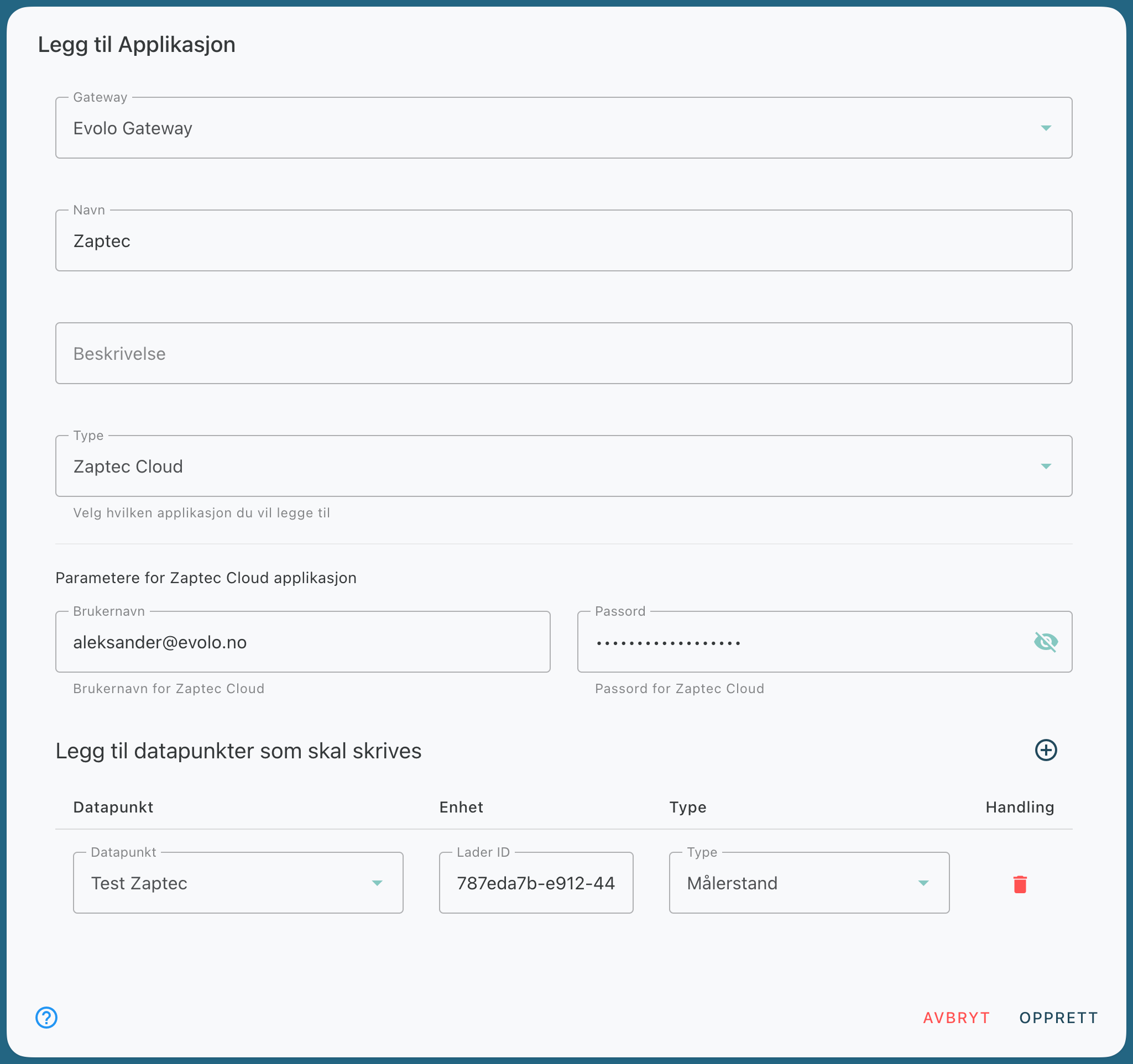
Enter a name, a description (if desired), and select a gateway.
Enter your username and password for the Zaptec Portal.
Click "Get Chargers."
Select the chargers and the types of data you want to retrieve, then click Add.
Select or create a virtual data point for each row.
Click "Create."

Fields you must fill in
Name and description
Give the application a name and add a description if desired.
Gateway
Select the gateway for the data points to be used.
Username
Enter your Zaptec Portal username.
Password
Enter your password for the Zaptec Portal. If you are editing an existing application, this field can be left blank.
Chargers
Click “Get Chargers” to view all chargers your account has access to.
The list shows the name, serial number, and installation location; chargers that have already been added are marked “In Use.”
Select the chargers you want to use and the types of data to retrieve for each charger. When you click “Add,” you’ll see one row per charger and data type, pre-filled with the relevant information.
Data
Points Select the data points to which you want to write data. We recommend using a vVirtual data point with data store types.
Type
Shows the type of data the row retrieves and is automatically populated based on the selection you made in “Retrieve Chargers.” You can change the type for each row. See the overview below for the types you can retrieve.
An application can have a maximum of 100 data points. The gateway must be connected in order to retrieve the chargers.
Data Types You Can Retrieve
You can retrieve these values from Zaptec:
Meter reading – energy consumption in kWh
Is online? – whether the charger is connected to the network
Temperature sensor 1 – temperature from sensor 1 in °C
Temperature sensor 2 – temperature from sensor 2 in °C
Humidity sensor – humidity in %
Voltage phases 1, 2, and 3 – voltage in V
Current, Phases 1, 2, and 3 – current in A
Active Phases – number of phases in use
Charging power – power in kW
Charging time – time spent on the current charging session in seconds
Ground fault current – recorded ground fault current in mA
Operating mode
Set charging current – maximum allowed charging current in A
Warning – error or alert from the charger.
Operating mode
The operating mode can have the following values:
0: Unknown
1: Disconnected
2: Connected – charging request
3: Connected – charging
5: Connected – charging complete.
Once the application is set up, the gateway retrieves data regularly and stores it in the selected data points. The frequency depends on the number of chargers: approximately every 12 seconds per charger, and at least every 20 seconds. With 10 chargers, this amounts to approximately every 2 minutes.